Rules of SteamLeaf
Introduction
Steam Leaf is a tactical wargame for two players. The players will equip their faction, and try to achieve their faction’s objective while preventing their opponent’s faction from achieving theirs.
- Players
- 60 - 90 mins
- Ages 10 +
Index
General
Factions
The Steam Guild are a collaboration of badgers, beavers, and weasels, with steam-powered technology to aid them in battle. The Leaf Coven are a group of foxes, racoons, and bobcats, who specialise in nature-based magic.
The basics of play
Your faction will have a mission objective. This is the goal you are trying to complete. To win the game, you must achieve your faction’s objective and stop your opponent from achieving theirs. (If both parties achieve their objective, or if both fail, the game ends in a draw.)
When you achieve (or fail) your objective, you must announce this to your opponent. The game ends when both mission objectives have been achieved or have failed.
The board
The game board has two sides: a market, and a garden. Choose your preferred side to play.
There are five types of tile on the game board.
-
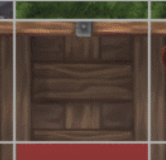 Indoor tiles (brown)
These represent the inside of buildings. The interior of a building is considered to be open space; there are no separate rooms once inside.
Units can only move from indoors to outdoors by passing through a doorway. -
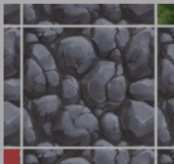 Outdoor tiles (grey)
These represent roads between the buildings. -
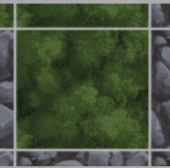 Obstacle tiles (green)
These represent obstacles on the ground. Units cannot stand on these tiles, but they can see over the top of them. -
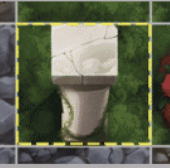 Obstacle tiles (yellow)
These represent tall obstacles. Units cannot stand on these tiles, see over the top of them, or shoot across them. -
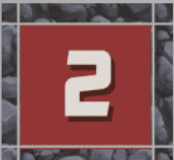 Obstacle tiles (red)
These are special obstacle tiles, with the same rules as basic (green) obstacle tiles. They are used to complete your faction’s objective.
Game setup
Each player must select a mission objective at random from the objective cards for their faction. Do not reveal what objective you have been given.
Agree on the power level your game will use, and create your faction. Select units, equipment or charms, and tactical cards. Do not reveal any of your chosen items to your opponent.
Position your units on the board. Roll a die to determine which player will place their units first. The starting player can deploy their units into any of the tiles in their chosen quadrant; then, the other player can deploy their units into the tiles of the opposite quadrant.
Creating your faction
Power Level and Unit Purchase
Both players must agree on a POWER LEVEL for their game. A power level can be any number, but as a rough guide:
- 150 points – low powered
- 300 points – average power
- 500 points – high powered
The game is not optimised for power levels lower than 150 or higher than 500. The power level dictates how many points you have to spend on buying units.
Example: Sarah and Luke have decided on a 300-point game. Sarah now has 300 points to spend on buying Steam Guild units. She purchases a Badger Guild Master (50 points) and a Beaver Head Engineer (30 points), two Weasel Taskmasters (80 points total), six Badger Soldiers (60 points total), one Badger Marksman (20 points), and four Weasel Trackers (60 points total)
Unit Types
Each unit type plays an important role in the game:
- LEADERS - are single units that act independently and have the ability to interrogate enemies and interact with objective tiles.
- FOLLOWERS - usually operate in SQUADS (linked groups), working to protect their Leaders and subdue enemy units. Followers can gain benefits from working with Leaders (for instance, Followers in base contact with a Badger Guild Master will increase their resolve and defence stats).
It is important to create a faction with a variety of unit types. An army of
all Leaders would quickly be surrounded by enemy Followers and unable to
achieve anything; an army of all Followers would be weakened without access
to Leaders, and could not complete most objectives.
Squads are made up of units of a single type. You must designate them as a
squad at the game’s beginning; you cannot create a squad halfway through play.
Equipment/Charms
The number of units in your faction will dictate how many equipment/charms you can use. The amount you can pick from is equal to half the number of units in your faction, rounded down. So, if you had 8 units you could select 4 equipment/charms; if you had 11 units you could select 5
The equipment/charm must be allotted to a specific unit. Leader units can use as many as they like; Follower units can have a maximum of two, but every member of their squad will receive the benefits of the card
If your faction includes Beaver Head Engineers or Racoon Leaf Mages, you will receive bonus equipment/charm cards.
When an equipment or charm indicates to increase a dice it will increase the base dice number by 2, meaning D6 becomes a D8 for example. The dice roll increase is always capped at a D12 size, a dice roll cannot be higher than a D12. In the same reguard when the item is said to decrease a defenders dice roll it will also be decreased by the same increment and to a minimum of a D4
Tactical Cards
Each player can select 5 tactical cards for use at any point in the game. (If
your faction includes Badger Guild Masters or Fox Rangers, you will receive
additional tactical cards.)
These tactical cards could give you access to more equipment/charms cards. If
you choose one of these, equip your units with their extras now.
Steam Guild Equipment
Leader Equipment
Steam Musket: Leaders attack gains Range 6+D4
Steam Powered Armor: Increase leaders defence dice
Steel Shield: When rolling defence roll two dice and take highest result
Great Weapon: Unit is able to make non ranged attack from one square away,
attack dice increase
Medical kit: Instead of making an attack action the leader can make a resolve
roll to regain health equal to the result up to their base health or restore the
health of a unit within one square
Refined Steel Armor: The unit increases its base health by 4.
Follower Equipment
Refined Steel Weapons: When rolling attack, roll two dice and take highest
result
Extra armor: Increases units base health by 2 and lowers base movement by 1
Great Shields: Badgers only, Increase units defence dice if that unit did not
move in players turn
Telescopic goggles: Ranged units only, increases range dice
Clockwork oath replayer: Units increase resolve dice
Duel weapons: Weasels only, Units can make 2 attacks but decreases range
dice.
Leaf Coven Charms
Leader Charms
Storm Caller: Leaders attack gains Range 4+D6, Defending rolls against attack
with resolve in addition. If the resolve roll is lower that unit is moved back one
square if possible
Wind rider: Increase leaders movement dice
Mystic Barrier: When making a defence roll the unit may use resolve instead
Spider Web: Optional ranged attack, range D4, defender uses resolve. If resolve
result is lower the affected unit cannot move for one turn
Shadow Walker: The unit may chose to be unattackable after it has moved for
one turn but cannot preform any other action aside movement
Healing Waters: The unit regains one health point at the start of each turn
until the reach their full health. Increases base health number by 2.
Follower Charms
Oaken Blessing: Increases unit defence dice
Whistling Arrows: Foxs only, Increase range dice
Swift Claws: Bobcats only, unit attacks twice if moved at least 5 squares before
attack action
Thunder Strike: Defenders defence roll is one dice lower
Spirit Shield: Unit can use resolve for defence but may not attack next turn
Constricting Attack: After a non ranged attack the defending units movement
is halved for that turn.
Game play
Taking Action
Your faction will have several UNITS people you have placed on the game board. During your turn, you can use any or all of your units, one at a time.
In a single turn, Follower units can:
- make a move
- attack an opposing unit
In a single turn, Leader units can:
- make a move
-
one of:
- attack an opposing unit
- interrogate an opposing unit
- make an OBJECTIVE ACTION
Basic Movement
To move a unit, you roll the die listed under their Move stat (for instance, to move a Fox Archer, you would roll a D6) and then add any other listed numbers (a Fox Archer’s movement stat is 4+D6, so you would add 4 to the result of your D6 roll). The total will be the number of tiles the unit can move in any direction. Units cannot move diagonally.
Squad Movement
To move a squad, you roll a single movement die for the entire squad. The total
will then be applied to every member of the squad.
Move every squad member in turn, always maintaining base contact between
all units in the squad
Base Contact
If two units are in adjacent squares (including diagonally), they have base
contact.
The units of a squad must always remain in base contact with each other. Each
member must be in contact with at least one other squad member, so that the
entire squad is linked. If a unit in the middle of the squad is eliminated so that
the squad is no longer linked, the squad must move back into base contact
before they can take any other movement actions.
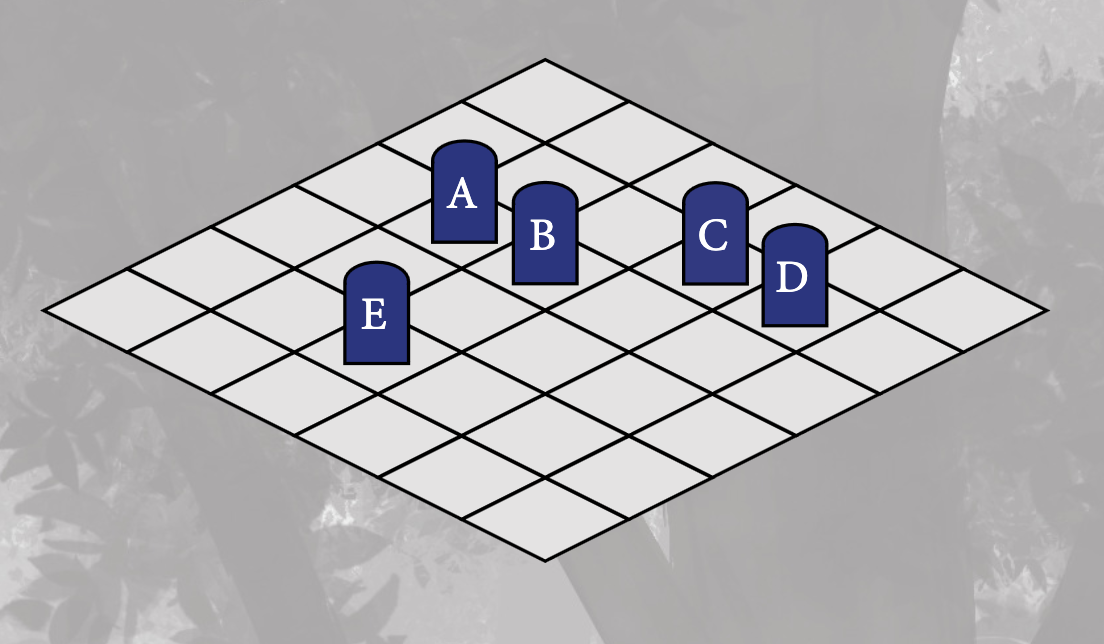
In this diagram, units A, B, C, and D are all in base contact. Unit E is not, and will not be able to take further movements until the others regain contact with it. If a member of the squad is in base contact with a leader, the leader will affect the entire group.
Melee Attacks
For a melee attack, the attacking unit must be in base contact with the
defending enemy unit.
The attacking player announces their intention to attack, and rolls the attacking
unit’s Attack die. Their opponent rolls the defending unit’s Defence die. If the
attack total is higher than the defence total, the number difference is subtracted
from the defending unit’s Health total
Example: Sarah uses her Badger Guard to attack Luke’s Fox Archer. She rolls a D6 Attack die, and Luke rolls a D4 Defence die. Sarah rolls a 5; Luke rolls a 3. There is a two point difference, so the Fox Archer loses 2 Health points.
Ranged Attacks
Some Follower units can make ranged attacks. To make a ranged attack, you
must first roll to determine whether the target is within range, and then roll for
attack/defence as if it’s a melee attack (described above).
Ranged attack stats are given for each unit. Roll, and add the relevant numbers
to determine the unit’s range. (For instance, a Badger Marksman has a range
of 4+D4. Roll a D4, and add 4. The total will be the unit’s current attack range;
enemy targets must be within that number of tiles to be attacked.)
Ranged attacks can only be made when you have line of sight; you can’t shoot
around corners!
You can shoot through one of your own units but only if it is direct contact
with the unit that is firing.
Calculating Diagonal Range
If a target is in a straight line of tiles, horizontally or vertically, from the
attacker, range is simple to determine. If they are on a diagonal path, it is
slightly more complicated.
Count the number of tiles from attacker to target in the horizontal direction,
and the number of squares in the vertical direction. The range is equal to the
larger number plus half the smaller number (rounded up).
Here is a diagram to help explain:
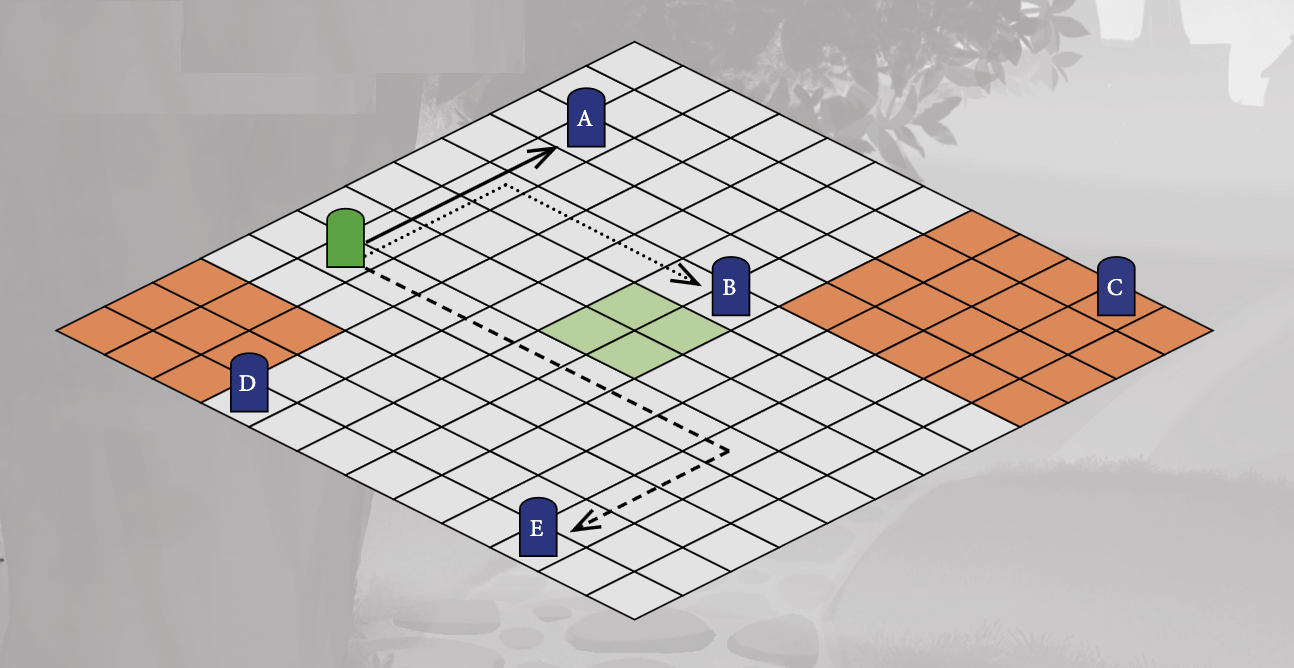
The green Leaf Coven unit is wanting to make a ranged attack
on one of the five Steam Guild units.
Unit A is 5 squares away. He needs a range for 5 for a
successful attack.
Unit B is on a diagonal path: 3 squares in one direction, and
5 squares in the other. The range needed is 5 plus half of 3
(rounded up, this is 2). So, he needs a range of 7.
Unit C is inside a building. He has no line of sight to this unit,
and cannot attack.
Unit D is around a corner. He has no line of sight to this unit,
and cannot attack.
Unit E is on a diagonal path: 8 squares in one direction, and 4
squares in the other. The range needed is 8 plus half of 4. So, he
needs a range of 10.
Line of sight
If two units are within the same building, and you could draw a straight line
from one unit to the other without it passing through any walls, the two units
have line of sight.
If two units are both outdoors, and you could draw a straight line from one
unit to the other without it passing through any walls, the two units have line
of sight.
The only tiles that have line of sight from inside a building to outside (or
outside to inside) are those directly next to a doorway. So, if a unit is standing
outside right next to a doorway, they can have line of sight anywhere into the
building (except for around corners) and anyone standing inside the building
can see them. Likewise, if a unit is inside right next to a doorway, they have line
of sight of any units outside (except for around corners), and anyone standing
outside can see them.
Obstacle tiles and objective tiles do not affect line of sight.
Health
Every time a unit is successfully attacked, their Health rating is lowered.
When a unit’s Health drops to 0, they are considered to be defeated, when this
happens replace that model with an X token; they can now be eliminated or
interrogated for information.
If a defeated target is attacked, they will be eliminated and the X token is then
removed from the game board. If the defeated target is interrogated the X
token is removed in the same way
Hidden Units
Initially, all your faction’s units will be HIDDEN Your opponent will be able to see that you have a unit or squad there, but not what it is. When creating your roster for the mission, assign a number to each unit and squad. When setting up the units place down a numbered token or tokens for squads based on that units number designation. To find out what your opponent’s units are, you must move one of your units into line of sight with one of theirs. Once LINE OF SIGHT is achieved, the unit will be revealed, and will stay revealed for the rest of the game.
Interrogation
A Leader unit can use their second action (after moving) to interrogate a defeated enemy unit. To do this, the attacking player announces their intention to interrogate, and rolls the attacking unit’s Attack die. Their opponent rolls the defending unit’s Resolve die. If the attack total is higher than the resolve total, the interrogation is successful, and the attacking player can find out information.
If the defeated unit is a Follower, the attacking player can:
- choose one of their opponent’s tactical cards at random, and find out what that card is
- choose one of their opponent’s concealed units, and unconceal them
If the defeated unit is a Leader, the attacking player can:
- look at all tactical cards held by their opponent
- lunconceal all their opponent’s concealed units
- ask what their opponent’s objective is Asking about the objective must be done in the form of a yes/no question: the attacking player can choose a mission and ask “Is this your objective?” and the opponent must answer truthfully. They cannot ask outright “What is your objective?”
Objective Actions
Some objectives require actions, to be taken at objective tiles. To take these actions, a Leader unit must be in base contact with the objective tile. The player must announce that they are making an objective action – but they do not need to specify what action this is if their objective is still unknown to their opponent.
Missions
About
At the start of the game, you will be randomly assigned a mission objective. Each mission has a different victory condition. To win the game, you must achieve the given victory condition and prevent your opponent from achieving theirs.
When you believe that you have achieved victory or defeat, you must announce this to your opponent. It is important that you do not tell them what mission you have achieved victory on: some missions require you to maintain your success until the end of the game. For instance, if your mission is “Demoralisation”, you should announce your victory when your Leader unit has successfully completed the third interrogation. You could still fail, if your opponent then eliminates the Leader unit before the end of the game
To make an objective action, the Leader unit must be in base contact with the chosen objective tile. They can still move on their turn, and defend if necessary, but they cannot attack or interrogate enemy units.
For some of the missions, you are asked to choose objective tiles or Leader units. Make a note of your choices, but do not reveal these to your opponent until you achieve victory.
Some missions use the term “when your opponent’s army reaches half its size”. This is measured by points value – if they originally had 200 points of units, their total units remaining must cost less than 100 points.
Steam Guild Missions
Bolster Defences
Choose 3 objective tiles. You must send troops to defend them.
The objective tiles can be destroyed if your opponent directly attacks them.
They will be destroyed by a single attack action from a Leader, or by 3
successive attack actions from Follower units.
You will achieve victory if 2 of the chosen tiles are still intact when your
opponent’s army reaches half its original size.
Top Secret Orders
Choose a Leader unit, and an objective tile. This unit is carrying vital
information that must be delivered safely to the objective tile.
To deliver the information, the Leader unit must spend a turn making an
objective action at the nominated objective tile. A marker is then placed on the
objective tile, to signify the successful delivery.
Once delivery is achieved, the objective tile and information marker will be
destroyed by 2 successive attack actions from any enemy units.
You will achieve victory if the information is successfully delivered and the
objective tile is then defended until your opponent’s army reaches half its
original size.
Escort Nobility
You must escort a high ranking official into your opponent’s quadrant, and to the edge of the game board. This noble is placed on the board at the start of the game, along with your other units – and cloaked, so your opponent will not be able to tell that he is not a regular unit. You will move the noble like a regular unit, during your turn.
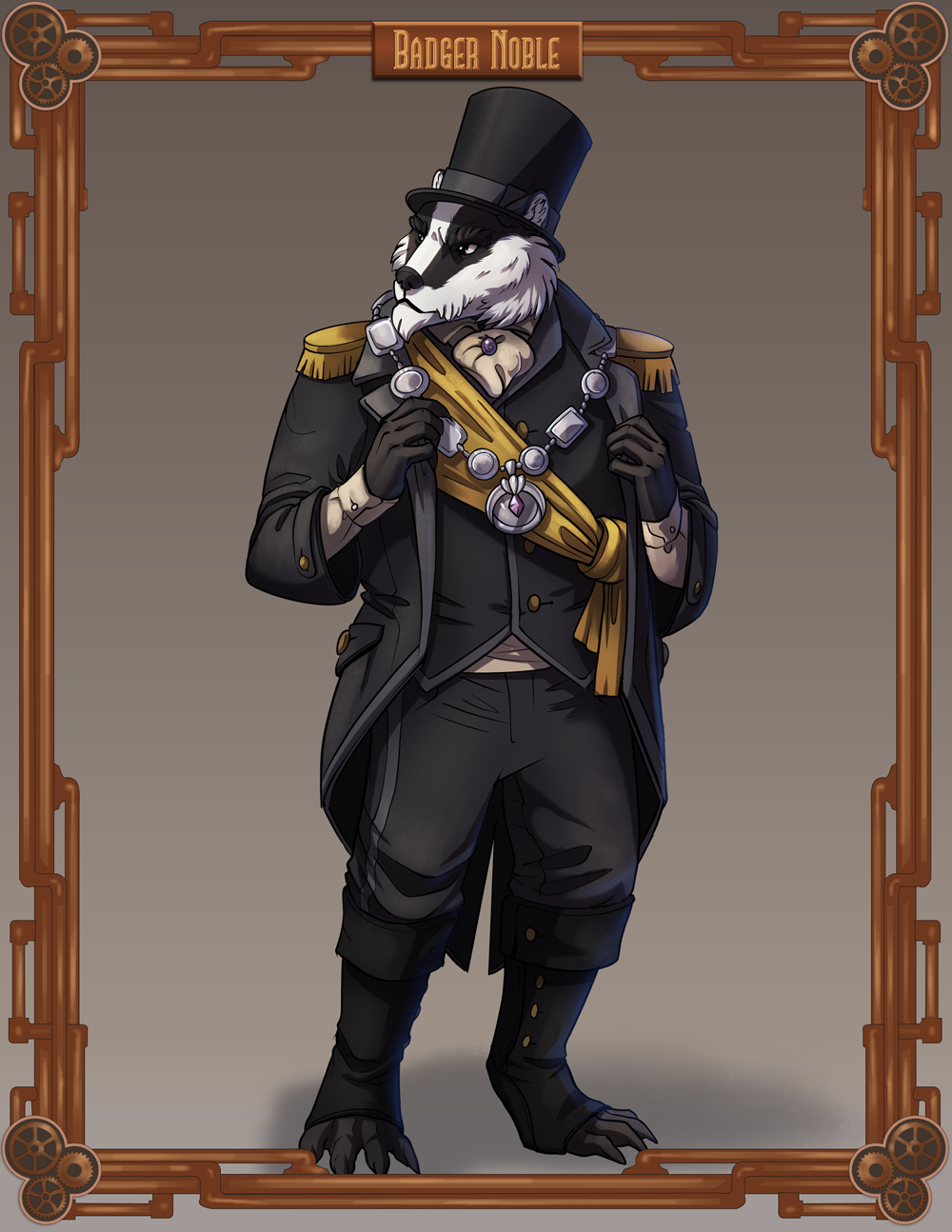
The noble has the following stats:
- The Noble
- Move: 6 + D4
- Attack: (none)
- Defence: D6
- Resolve: D12
- Health: 6
You will achieve victory if the noble reaches a board edge in your opponent’s starting quadrant without being successfully interrogated or eliminated by your opponent’s units. At this point, he is removed from the board.
Security Sweep
Choose 3 objective tiles, 1 Leader unit, and 1 more objective tile. The 3
objective tiles contain vital information gathered by security agents. The Leader
must visit each tile in turn, and perform an objective action to collect the
information.
You will achieve victory when the Leader performs an objective action to
deliver the information while in base contact with the drop point.
Demoralisation
Choose a Leader unit. This unit must perform successful interrogations of at
least 3 enemy units.
You will achieve victory if your Leader performs 3 successful interrogations
and manages to remain undefeated until the game ends.
The Great Contraption
Choose an objective tile in your starting quadrant. You must build and defend a new contraption on this tile.
To build the contraption, a Leader unit
must perform 6 objective actions at
the nominated objective tile. After the
first objective action, the contraption
is considered “uncompleted”. When
all 6 actions have been performed, the
contraption is considered to be complete.
The uncompleted contraption can be
destroyed by 3 successive attack actions by
enemy units.
The completed contraption has the following stats:
- The Contraption
- Move: (none)
- Attack: D10
- Defence: D10
- Resolve: (none)
- Health: 15
- Range: D6
- Number of targets per attack: D4
You will achieve victory if your contraption is successfully completed and remains intact until the end of the game.
Leaf Guild Missions
Learn All We Can
Choose an objective tile outside of your starting quadrant. You must send a
Leader unit to it, to make objective actions for 5 uninterrupted rounds – if the
Leader uses a non-move action to attack/interrogate instead, they must begin
again at the start.
You will achieve victory if you successfully keep a Leader unit at the chosen
objective tile for all 5 uninterrupted rounds. You will fail if your opponent
eliminates all your Leader units.
Sabotage
Choose a Leader unit, and an objective tile outside of your starting quadrant.
This Leader has a bomb which must be delivered to the chosen objective tile,
and armed (using an objective action). When the bomb is armed, place a
marker on the objective tile.
The bomb will explode 6 turns after being armed, unless it is first disarmed.
This will end the game immediately. If your opponent’s mission is “The Great
Contraption”, the bomb’s explosion will also destroy their contraption, whether
completed or uncompleted – which will cause their mission to fail.
The bomb can be disarmed by 3 objective actions. These can be made by one
Leader, or by multiple Leaders (in the same turn, if they wish).
You will achieve victory if at least half your Leader units (rounded up) escape
back to your starting quadrant before the bomb explodes.
Great Distraction
Your aim is to keep enemy units out of your starting quadrant.
“Initial contact” with the enemy is made as soon as opposing units are in sight
of each other and thus uncloaked. 10 turns after initial contact, your opponent
must have no units within your starting quadrant.
You will achieve victory if, at the end of the 10th turn after initial contact is
made (the initial contact happening during the 1st turn), there are no enemy
units within your starting quadrant, and every unit that had entered has been
eliminated (not just allowed to retreat).
Remove Hidden Agent
Choose an objective tile in your opponent’s starting quadrant. There is a secret agent hiding at this location. You must make contact with them, and escort them back to your starting quadrant.
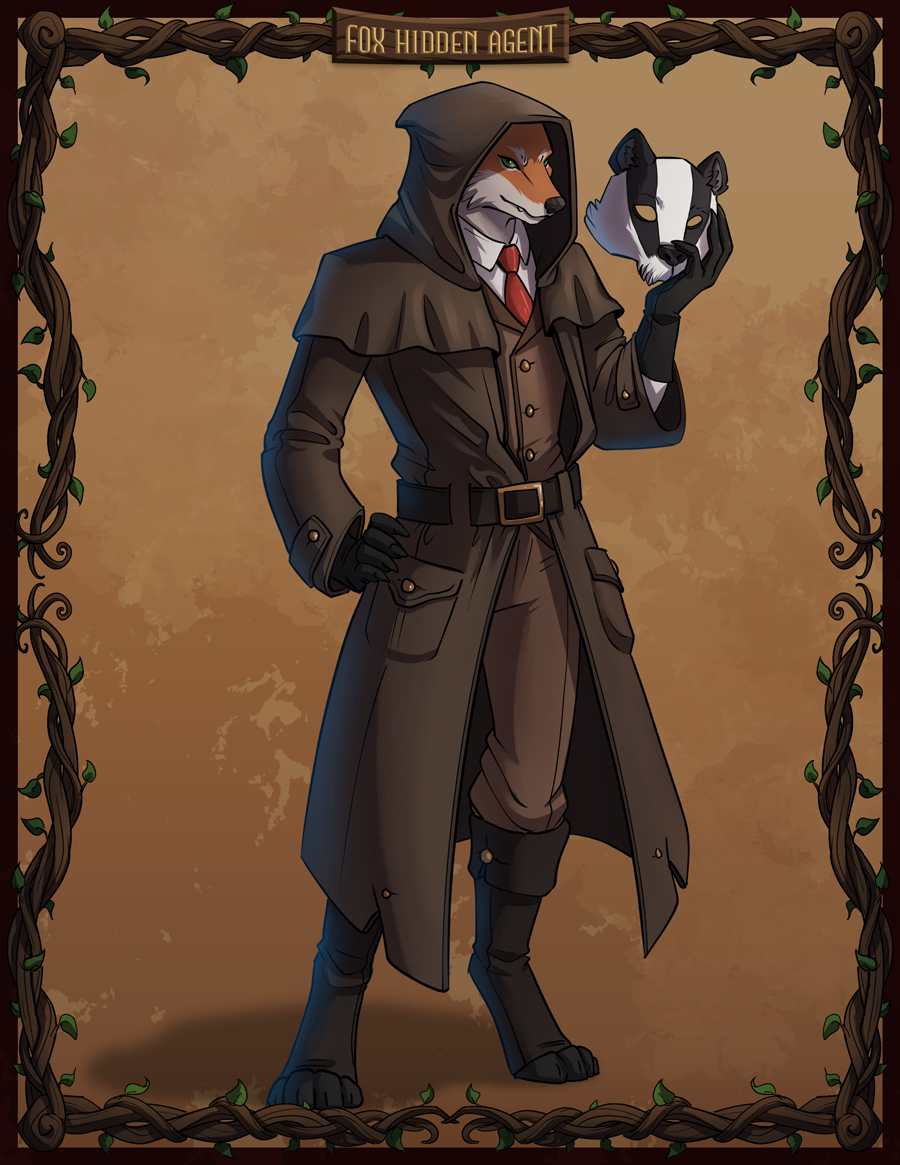
- The Secret Agent
- Move: 4 + D4
- Attack: (none)
- Defence: D8
- Resolve: D12
- Health: 5
You must send a Leader to the
chosen objective tile. This Leader
will make an objective action, and
you can immediately place the
agent’s marker on the board, in base
contact with the objective tile.
Once the agent’s marker is present
on the board, you can move them
like a regular unit, on your turn.
You will achieve victory if the agent returns to your starting quadrant and is
not eliminated by the game’s end.
Plant False Information
Choose 4 objective tiles outside your starting quadrant, and a Leader unit. The
Leader must plant false information at all the chosen objective tiles, by make
an objective action at each tile.
You will achieve victory if a Leader makes an objective action at each chosen
objective tile.
They Must Fail!
Your only mission is to stop your opponent from succeeding at theirs.
This mission can drastically alter the type of units you choose to purchase, and
what tactics you will use during game play. The idea is to trick your opponent
into thinking that you are trying to complete a particular mission so that they’ll
use their efforts to stop you rather than trying to achieve their own victory.
You will achieve victory if your opponent fails. You cannot achieve a draw in
this game.